
I run a water purification plant in Mexico, where we wash, disinfect, fill, cap, and seal reusable 19-liter (5-gallon) water jugs. Working with this type of operation has taught me that buying a reverse osmosis system is only one part of building a reliable water refill business.
If I were planning a small operation in Texas, Florida, Arizona, or California, I would start with three things: the amount of water I need to produce each day, the quality of the source water, and the requirements for operating a drinking-water business in that location.
My original equipment budget is $8,950–$16,500 for a small setup. That is a preliminary planning estimate, not a verified all-in cost for opening a compliant facility in the United States. Building modifications, plumbing, installation, permits, laboratory testing, and working capital may add substantially to the total.
There is also an important difference between selling 100 five-gallon refills per day and producing 2,000 full jugs daily. Those are two very different operations, and the water treatment system must be sized accordingly.
How Much Does a Small Water Purification Plant Cost?
The cost depends on the source water, production target, level of automation, and condition of the building. A basic refill operation using an existing suitable facility may have very different startup costs from a new bottling plant that needs extensive construction and equipment.
Here is how I would organize the initial budget.
| Cost category | Preliminary estimate |
|---|---|
| Commercial reverse osmosis system | $2,500–$4,000 |
| Listed disinfection components | Approximately $683–$763 |
| Manual washing, filling, and capping equipment | Approximately $1,570 |
| Water refill or vending equipment and storage rack | $800–$3,000 combined |
| Installation, permits, testing, building work, and working capital | Not yet quoted |
These are planning figures based on the original equipment list, not confirmed current supplier prices. The categories may not cover every component required for a working facility, and some equipment may need to be upgraded.
For comparison, a small water refill station is not the same as an automated bottled-water factory. The latter may require additional production equipment, packaging machinery, storage systems, and a much larger capital investment. Get quotations for the complete process rather than comparing prices for individual machines alone.
The 4 Equipment Levels I Would Evaluate Before Opening
LEVEL 1: The Heart of the Plant — Commercial RO System 1000 GPD ($2,500–$4,000 estimated)
A commercial reverse osmosis (RO) system is designed for a different workload from a typical household drinking-water filter. The right unit depends on feed-water quality, operating pressure, temperature, membrane performance, and the amount of finished water you need.
My original setup uses a commercial RO system with two membranes and a booster pump. I have recorded total dissolved solids (TDS) readings of 8–12 ppm after RO at my plant.
That is my operating experience, not proof that the water is safe to drink. TDS measures the combined concentration of dissolved substances; it does not identify every contaminant or replace microbiological and chemical testing.
Before buying a commercial water treatment system, work out your daily production target. One hundred five-gallon refills require 500 gallons of finished water per day, before accounting for process losses and cleaning. Two thousand five-gallon jugs require 10,000 gallons of finished water per day.
A system rated at 1,000 gallons per day cannot supply 10,000 gallons of finished water daily. Even a 2,000-GPD unit would be insufficient for that target. Actual output also depends on operating conditions, water recovery, downtime, and maintenance.
LEVEL 2: Water Disinfection — UV, Ozone, and Silver-Ion Systems
Disinfection is a critical part of a drinking-water operation, but the treatment method should be selected for the actual water source and the requirements that apply to the facility.
My original setup uses silver ions and ozone. I can describe my experience with that equipment, but I would not assume that the same arrangement will satisfy US requirements or guarantee a particular shelf life in every operation.
Why UV Treatment Needs to Be Designed Correctly
Ultraviolet treatment can inactivate susceptible microorganisms when the equipment provides the required dose under the intended operating conditions. Performance depends on factors such as water clarity, flow rate, lamp condition, and system design.
UV does not leave a disinfectant residual in the water. For that reason, clean storage tanks, properly sanitized reusable jugs, hygienic filling procedures, and suitable caps remain important after treatment.
A jug that develops slime or biofilm should not be assumed to be safe simply because the water passed through a UV unit or another disinfection system.
What to Know About Silver-Ion Treatment
My original system uses a silver-ion generator after reverse osmosis. Before choosing a similar product for a US facility, verify its intended application, materials compatibility, technical documentation, and compliance with applicable requirements.
Do not assume that adding silver guarantees six months of antimicrobial protection, eliminates all biofilm, or makes the finished water compliant. Those claims need appropriate evidence and regulatory review.
What to Know About Ozone
Ozone is used in some water treatment and sanitation applications. Its effectiveness depends on the equipment, concentration, contact conditions, water chemistry, and operating procedure.
Do not rely on a fixed claim that ozone always disappears within 20 minutes. Residual concentration and decay depend on operating conditions. Commercial equipment should be selected and operated with appropriate controls and safety precautions.
Disinfection Equipment on My Original List
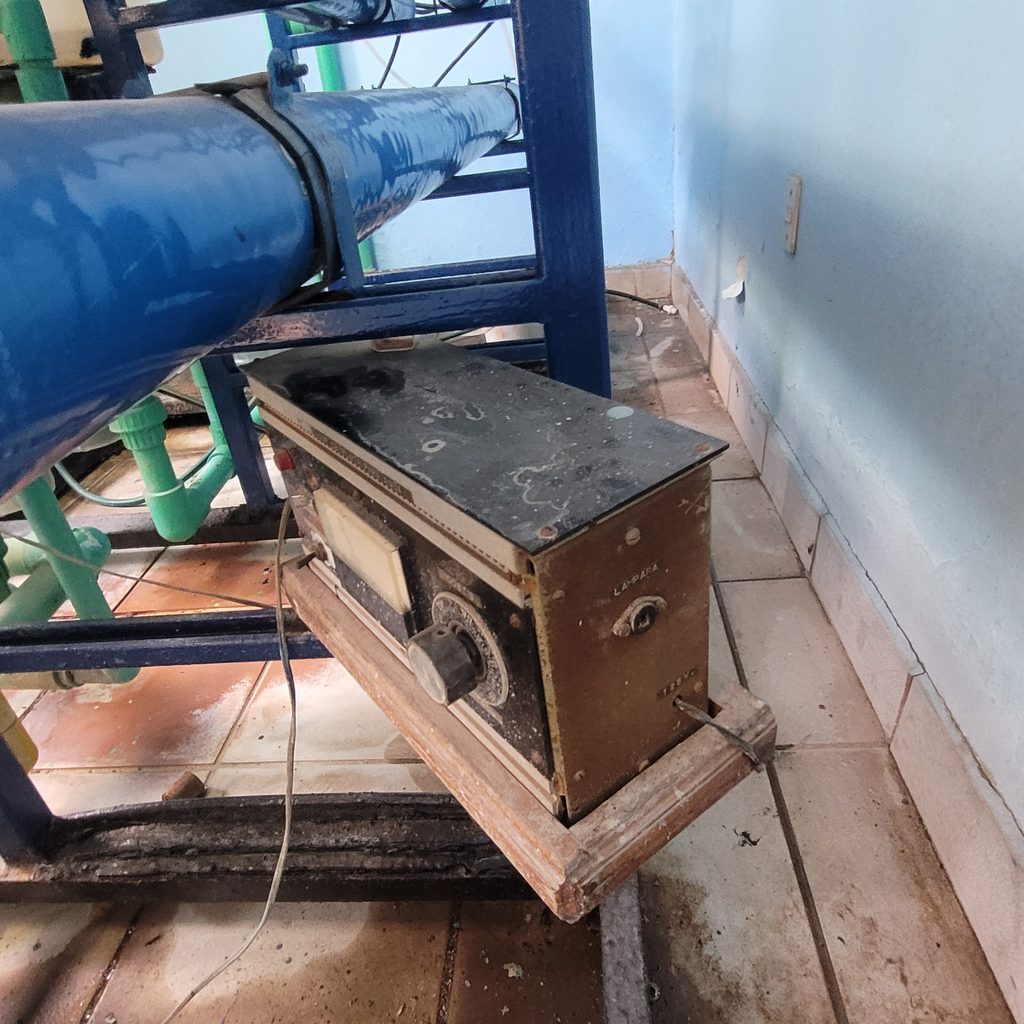
This is the silver ionization unit in my water purification plant in Mexico, located directly under 4040 RO membranes (blue cylinders). The box has a dial to control the silver ion concentration. It uses two pure silver electrodes that release Ag⁺ ions into the purified water stream. This is the final sterilization step before the 5-gallon jugs are filled. Combined with the ozone generator, this creates double protection: ozone for the empty jug and silver ions for the water inside. The unit has been running since 2018, producing approximately 2,000 jugs per day. Note the water stains and rust—proof of a real operating plant, not a stock photo.
These are the original product categories and prices, not verified recommendations that the equipment is suitable for commercial drinking-water production. Confirm the specifications, intended use, treatment performance, and applicable requirements before purchasing.
In the United States, bottled drinking-water operations are subject to FDA requirements, including applicable standards for product quality and sanitary processing. State and local requirements may also apply. Do not assume that UV is universally mandatory or that a particular combination of technologies automatically makes a plant compliant.
For official guidance, see the FDA’s bottled-water regulatory information and 21 CFR Part 129.
LEVEL 3: Bottling — Washing, Filling, and Capping ($1,200–$4,500 estimated)
A water refill business needs more than a filtration system. Reusable five-gallon jugs must be inspected, washed, sanitized, filled under hygienic conditions, and closed properly.
Manual equipment may work for a small operation, but throughput depends on the number of workers, the design of the washing and filling stations, the condition of returned containers, and the time needed for sanitation.
My original equipment list includes:
- Three-head manual bottle washer for five-gallon jugs
- Manual five-gallon filling station with three heads
- Manual capping machine
The listed prices total approximately $1,570. That figure should not be treated as a complete installed bottling-area budget. Check whether the machines include the necessary pumps, fittings, food-contact components, drainage arrangements, and installation materials.
Pay particular attention to the layout. Returned containers should not contaminate clean jugs, and the filling area should be arranged to protect treated water and sanitized containers from contamination.
LEVEL 4: The Sales Area — Refill Equipment and Storage ($800–$3,000 estimated)
The final equipment depends on how you plan to sell your water. A self-service refill station, a delivery operation, and a retail counter have different space and equipment requirements.
My original list includes:
- Water vending machine or refill station
- Steel rack for 100 five-gallon bottles
Before ordering a vending machine, confirm its capacity, intended application, maintenance requirements, and compatibility with your water treatment setup.
Storage deserves the same attention. Plan separate areas for returned containers, washed jugs, finished products, caps, and other packaging supplies. Keep these areas clean and organize the workflow to reduce the risk of contamination.
Monthly Consumables: Caps, Seals, Filters, and Cleaning Supplies
Consumables are an ongoing expense, and the quantities you need will depend on the number of refills sold, the source-water quality, the treatment process, and your sanitation schedule.
The estimates below preserve the original quantities. The figures for 100 jugs per day assume 30 operating days and scale the original monthly cap and seal quantities proportionally. Filter and chemical usage must be determined from actual operating conditions rather than scaled automatically.
| Item | Original 2,000-jug/day estimate | Illustrative 100-jug/day estimate |
|---|---|---|
| Five-gallon caps | 60,000/month | 3,000/month |
| Tamper-evident seals or shrink bands | 60,000/month | 3,000/month |
| 20-inch × 4.5-inch sediment filters | 8 filters | 1 filter |
| Water softener salt | Four 40-kg bags | One bag |
| Chlorine for equipment washing | 20 liters | 2 liters |
These quantities are planning assumptions, not universal consumption rates. In particular, filter life depends on the water being treated and the filter specifications. Chemical use should follow the applicable instructions and a validated sanitation procedure.
Check that every cleaning product is suitable for its intended application, and follow the manufacturer’s handling and safety instructions. Never mix incompatible chemicals.
Caps and seals are recurring purchases, but recurring sales should not be confused with profit. Include the cost of every consumable in the operating budget.
How Much Profit Could a Water Refill Business Make in the USA?
The financial side of a refill business starts with a simple distinction: revenue is not the same as profit.
The original example uses the following assumptions:
| Financial assumption | Original example |
|---|---|
| Selling price per five-gallon refill | $5.50 |
| Estimated direct cost per refill | $0.90 |
| Difference before other expenses | $4.60 |
| Refills sold per day | 100 |
| Operating days per month | 26 |
Using those assumptions:
100 refills per day × $4.60 × 26 days = $11,960 per month.
The arithmetic is correct, but $11,960 is a potential contribution before other operating expenses, not net profit. The $0.90 direct-cost figure also needs to be checked against real purchasing and operating records.
A more complete business plan should account for:
- Rent and building expenses
- Employee wages and payroll taxes
- Electricity, water, and wastewater costs
- Filter replacement and equipment maintenance
- Laboratory testing and sanitation supplies
- Delivery vehicles, fuel, and distribution
- Insurance, permits, accounting, and taxes
- Equipment depreciation and financing
- Customer acquisition and other overhead
The selling price will vary by location, competition, delivery service, and whether customers bring their own jugs or purchase new ones. A business selling 100 refills every day may also experience slower days, seasonal changes, and customer churn.
My operating experience in Mexico gives me a useful point of comparison, but it does not prove that a US operator will earn five times more per jug. Labor, rent, utilities, compliance, and customer acquisition can all change the final result.
Before investing, calculate conservative, expected, and optimistic sales scenarios. Include the money needed to cover expenses while you build a regular customer base.
US Regulations: What to Check Before Opening
Buying the equipment does not automatically authorize you to operate a drinking-water business. The applicable requirements depend on the type of operation, the water source, the product, and the state and local authorities responsible for oversight.
Before signing a lease or placing equipment orders, investigate these areas:
- Source water and testing. Confirm that the source is acceptable and identify the required chemical, microbiological, and other analyses.
- Facility design and sanitation. Check requirements for container washing, filling areas, equipment, plumbing, and protection against contamination.
- Treatment and finished-water quality. Choose a treatment process suitable for the source water and verify that the finished product meets the applicable standards.
- Permits and inspections. Contact the relevant state health or food-safety agency and local authorities to determine which licenses, inspections, zoning approvals, and wastewater requirements apply.
- Records and operating procedures. Establish documented procedures for sanitation, testing, maintenance, and corrective action.
The FDA’s bottled-water regulations include 21 CFR Part 129, which addresses processing and bottling practices, and 21 CFR 165.110, which addresses bottled-water identity and quality standards.
The exact obligations for your proposed facility should be confirmed with the relevant authorities before investing. A treatment setup that works in one location may not be suitable for a different source of water or operating model.
My Free Amazon Idea List
My original equipment list is called “WaterPlantKit – 2000 Jug/Day Full Kit – 2026.”
Use the list as a starting point for comparing equipment, not as a complete engineering design or a guarantee that every component is suitable for a US facility. Check product specifications, compatibility, current prices, and installation requirements before ordering.
If you are starting smaller, begin with the number of refills you realistically expect to sell. Then size the treatment system, storage tanks, and filling equipment around that demand.
For example, 100 five-gallon refills require 500 gallons of finished water per day before process losses and cleaning. A target of 2,000 five-gallon refills requires 10,000 gallons per day. These two projects cannot be planned around the same 1,000-GPD RO system.
If you want to develop an under-$10,000 equipment plan for Texas, first establish your target output, obtain a source-water analysis, and check local compliance requirements. Those steps will help you determine whether the budget is realistic before buying equipment.
My Free Amazon Idea List
My original equipment list is called “WaterPlantKit – 2000 Jug/Day Full Kit – 2026.”
Use the list as a starting point for comparing equipment, not as a complete engineering design or a guarantee that every component is suitable for a US facility. Before ordering, compare product specifications with the actual daily output you need, the source-water analysis, and the sanitation process.
If you are planning a smaller operation, begin by calculating the number of refills you realistically expect to sell. Then size the treatment system, storage tanks, and filling equipment around that demand.
For example, 100 five-gallon refills require 500 gallons of finished water per day before process losses and cleaning. A target of 2,000 five-gallon refills requires 10,000 gallons per day. Those are very different projects and should not be based on the same 1,000-GPD system.
If you want to develop an under-$10,000 equipment plan for Texas, start with the intended output, source-water test results, and local compliance requirements. Those three things will help determine whether the budget is realistic before you buy anything.
Frequently Asked Questions
Can I start a water refill business with less than $10,000?
Possibly, if you have access to a suitable facility and need only a limited equipment setup. However, the total cost of opening a compliant operation may be considerably higher once installation, testing, plumbing, permits, sanitation, and working capital are included. Obtain local quotations before deciding how much money to invest.
Is a 1,000-GPD reverse osmosis system enough for 100 five-gallon refills per day?
One hundred refills require 500 gallons of finished water daily. A 1,000-GPD system may be sufficient under suitable operating conditions, but actual production depends on water quality, pressure, temperature, recovery rate, and downtime. Allow additional capacity for cleaning and process losses.
Do I need UV treatment to sell purified water in the United States?
Do not assume that one treatment technology is mandatory for every facility. Applicable requirements depend on the operation and its treatment process. The producer must meet the relevant drinking-water quality and sanitation requirements. Confirm your proposed design with the appropriate authorities and qualified treatment professionals.
Can I use silver ions or ozone instead of UV?
Do not substitute one method for another based only on personal experience or a supplier’s claims. Each treatment method must be suitable for the source water and intended application, and the overall process must meet the applicable requirements. Verify treatment performance, materials compatibility, and regulatory considerations before using the technology commercially.
What should I do before buying water treatment equipment?
Test the source water and calculate the required daily output. Those two steps help determine the pretreatment system, RO capacity, storage requirements, disinfection method, and likely operating costs. They also make it easier to compare supplier quotations and avoid purchasing equipment that cannot meet your actual needs.

Leave a Reply